
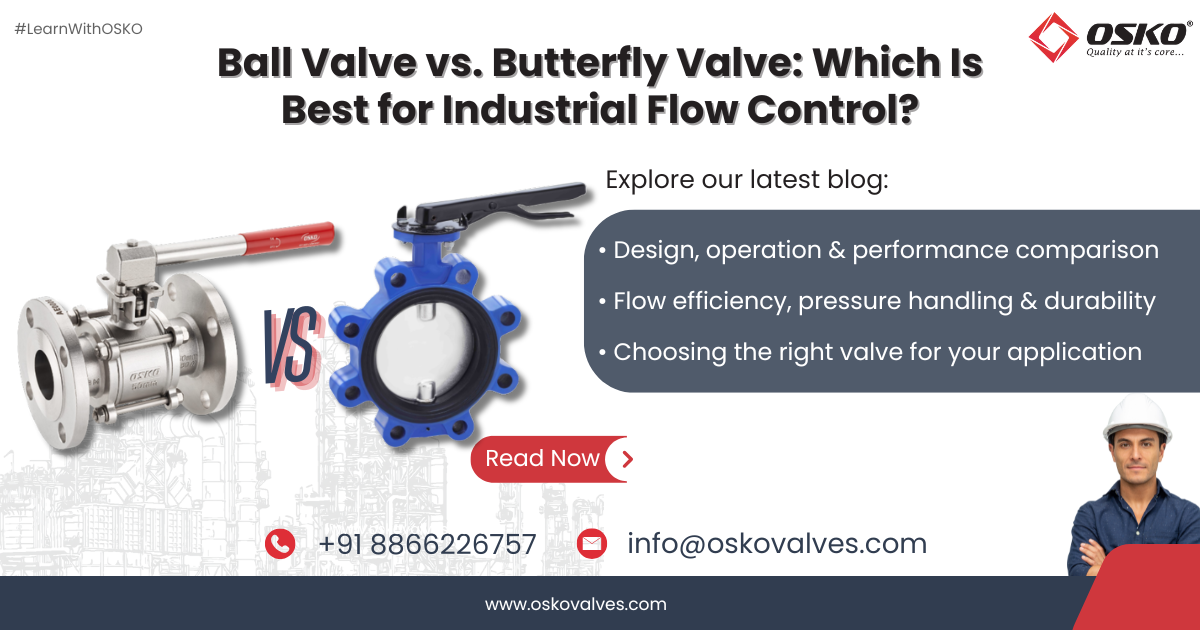
Ball Valve vs Butterfly Valve: Best Choice for Industrial Flow Control
Ball Valve vs. Butterfly Valve: Which is Best for Industrial Flow Control? (2026 Selection Guide)
Confused between Ball Valves and Butterfly Valves? We compare flow control, cost, and pressure ratings to help you choose. Discover why OSKO’s Wafer Type Ball Valves and ISI Marked Butterfly Valves are industry leaders.
Introduction: The Engineer’s Dilemma
Every pipeline engineer and procurement manager faces the same question eventually: “Do I need a Ball Valve or a Butterfly Valve?”
On the surface, both do the same job—they are quarter-turn valves that stop, start, and regulate flow. But choose the wrong one, and you could face unnecessary costs, heavy maintenance downtime, or poor flow control.
At OSKO Valves, we manufacture both. From our precision-engineered Wafer Type Ball Valves to our lightweight Aluminium Butterfly Valves, we know exactly where each excels. This guide will break down the technical differences to help you make the right choice for your specific application.
The Contenders: A Technical Overview
- The Ball Valve (The High-Pressure Specialist)
A ball valve uses a spherical ball with a hole (bore) through it. When the valve is open, the medium flows through the bore.
- Best For: High-pressure applications, strict shut-off requirements, and smaller pipe diameters (< 2 inches).
- OSKO’s Advantage: Standard ball valves can be bulky. That’s why we engineered the OSKO Wafer Type Ball Valve. It offers the sealing power of a ball valve but with a compact, short face-to-face design that saves massive amounts of space.
- Key Spec: Zero Holdup Area (prevents material stagnation).
- Rating: 150# Pressure Rating.
- The Butterfly Valve (The Large-Bore Efficiency King)
A butterfly valve uses a disc mounted on a rotating shaft. When closed, the disc blocks the line; when open, the disc rotates a quarter turn to allow flow.
- Best For: Large pipe diameters (> 2.5 inches), water treatment, HVAC, and applications where weight is a concern.
- OSKO’s Advantage: We specialize in Aluminium Butterfly Valves which are significantly lighter and corrosion-resistant compared to traditional cast iron. For critical safety projects, our ISI Marked Butterfly Valves guarantee compliance with Indian Standards (IS 13095).
Key Differences: How to Choose?
- Flow Control & Pressure Drop
- Ball Valves: When a full-bore ball valve is open, there is no obstruction. This means zero pressure drop. If your system cannot afford to lose pressure (e.g., firefighting lines), a Ball Valve is superior.
- Butterfly Valves: The disc remains in the center of the flow even when fully open. This creates a slight pressure drop. However, for large water lines or slurry, this is often negligible compared to the cost savings.
- Sealing & Leakage
- Ball Valves: Known for a “bubble-tight” seal. They are excellent for gas applications where even a tiny leak is dangerous. OSKO’s Mirror Finished Balls and floating ball design ensure low torque and a perfect seal.
- Butterfly Valves: High-performance butterfly valves (like our Double Offset models) offer excellent sealing, but standard rubber-lined ones are better suited for liquids rather than high-pressure gases.
- Weight & Installation Space
This is where the battle is often won.
- Small Lines (15mm – 50mm): Ball valves are standard. They are robust and handle the pressure well.
- Large Lines (50mm – 1000mm): A 10-inch Ball Valve is incredibly heavy, expensive, and requires a lot of space. A 10-inch OSKO Butterfly Valve is lightweight, fits between two narrow flanges (Wafer style), and is easy to install.
- The “Middle Ground” Solution: If you need the performance of a ball valve but have limited space, the OSKO Wafer Type Ball Valve is the perfect hybrid solution—compact design with full ball valve integrity.
- Cost Comparison
- Upfront Cost: For sizes below 2 inches, Ball Valves are cheap. As size increases, their cost skyrockets due to the material required for the heavy body and ball.
- Long-Term: Butterfly valves are generally 30-40% cheaper in sizes above 4 inches. They also have fewer moving parts, making seat replacement (especially in our reusable seat designs) easier and cheaper.
Quick Selection Cheat Sheet
| Feature | Ball Valve (Wafer Type) | Butterfly Valve (Aluminium/ISI) |
| Best Size Range | 15mm to 100mm | 50mm to 1000mm+ |
| Pressure Handling | High (Excellent for Gas/Steam) | Moderate (Excellent for Water/HVAC) |
| Flow Restriction | None (Full Bore available) | Slight (Disc sits in flow) |
| Weight | Heavier | Lightweight (esp. Aluminium body) |
| Maintenance | Low maintenance, long life | Easy seat replacement |
| OSKO Special | Integral ISO Mounting Pad for easy automation | ISI Marked for guaranteed safety |
Conclusion: Which OSKO Valve Do You Need?
- Choose the OSKO Wafer Type Ball Valve if: You have a line size under 4 inches, need high-pressure handling, zero leakage, and are tight on installation space.
- Choose the OSKO Butterfly Valve if: You are working with water, air, or slurry lines larger than 2 inches, need a lightweight solution, or require cost-effective flow control for a large facility.
Still unsure?
Don’t guess with your pipeline safety. Contact OSKO Valves today. Our engineering team can help you calculate the torque, pressure rating, and material compatibility to select the perfect valve for your project.
Explore Our Full Range of Valves Here
Popular Post
Categories
Recent Posts
- How to Buy Industrial Valves from an Indian Manufacturer
- Wafer vs Lug vs Flanged Valve: Which End Connection Is Best for Your Industrial Plant?
- How to Select the Right Valve for a Chemical Plant | Complete Guide
- ALUMINIUM BUTTERFLY VALVES: The Lightweight Champion of Industrial Flow Control
- Why ISI Marked Butterfly Valves are the Gold Standard for Industrial Flow Control