
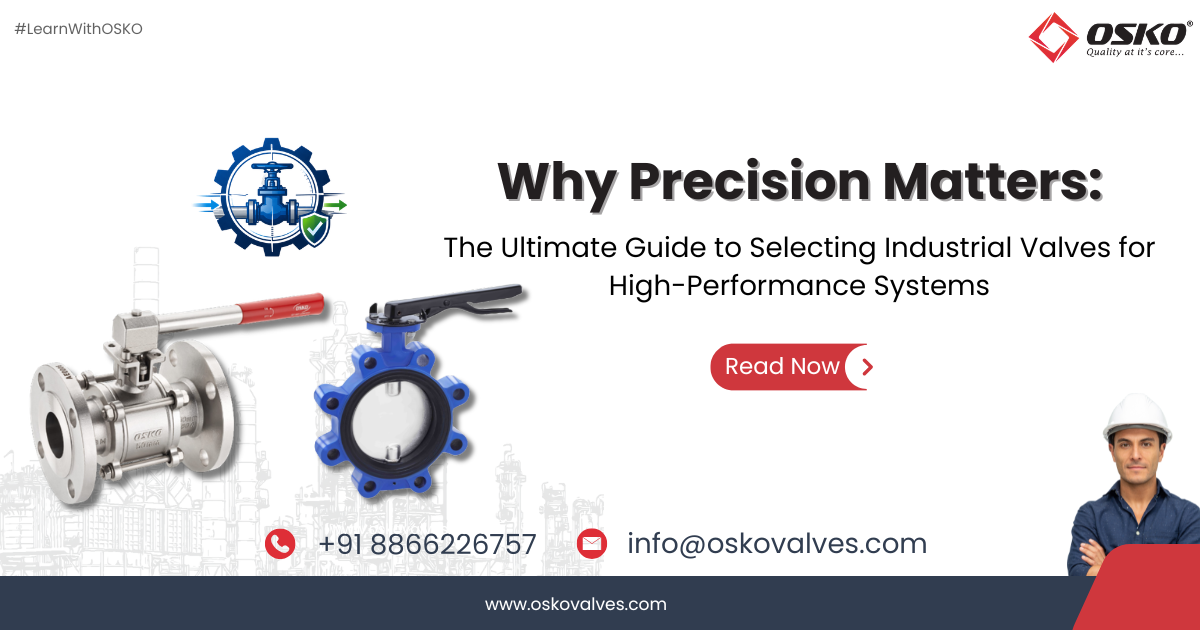
Why Precision Matters: The Ultimate Guide to Selecting Industrial Valves for High-Performance Systems
In the complex world of industrial fluid management, a valve is never “just a valve.” It is the heartbeat of your operational uptime. Whether you are managing a massive water treatment plant, a high-pressure oil & gas pipeline, or a precision-dependent chemical processing unit, the integrity of your flow control determines your bottom line.
At OSKO Valves, we believe in “Quality at its Core.” In this guide, we’ll explore how to choose the right industrial valves to eliminate leakage, reduce maintenance costs, and prepare your infrastructure for the future of automation.
- Understanding the Core: Ball Valves vs. Butterfly Valves
Choosing between a ball valve and a butterfly valve is the most common dilemma for engineers. While both are quarter-turn valves, their applications differ significantly:
- Ball Valves: Best for high-pressure systems and applications requiring a bubble-tight shutoff. OSKO’s Wafer Type Ball Valves are specifically designed to save space while offering zero-hold-up of material.
- Butterfly Valves: Ideal for regulating flow in large-diameter pipes. They are lightweight, cost-effective, and easy to operate.
- Pro Tip: For high-performance needs, look into Double Offset Butterfly Valves, which offer lower torque and extended seat life compared to centric designs.
- The Hidden Cost of “Cheap” Valves: Leakage and Downtime
Many procurement managers focus on the initial purchase price, only to be hit later by “hidden costs.” A minor leak in a chemical plant isn’t just a waste of product; it’s a safety hazard and a regulatory nightmare.
How OSKO Solves This:
- Precision Machining: Every OSKO valve is manufactured using CNC and VMC machinery to ensure micron-level accuracy.
- Rigorous Testing: We don’t just “spot check.” Every single valve undergoes hydrostatic and pneumatic pressure testing according to API 598 and IS 13095 standards before it leaves our Rajkot facility.
- Future-Proofing with Valve Automation
The industry is moving toward “Industry 4.0,” where manual operation is being replaced by remote monitoring and control. If your valves aren’t “actuation-ready,” you are installing yesterday’s technology.
Most OSKO valves come with an integrally casted ISO 5211 mounting pad. This allows for the seamless integration of:
- Pneumatic Actuators: For fast-acting, fail-safe operations.
- Electric Actuators: For precise, remote-controlled flow modulation.
- Industry-Specific Applications
Different environments demand different materials. Selecting the wrong body or seat material can lead to rapid corrosion.
- Water Treatment: Requires durable, ISI-marked butterfly valves for municipal and industrial scale.
- Chemical/Petrochemical: Needs high-grade WCB or Stainless Steel (CF8/CF8M) to handle corrosive media.
- HVAC & Firefighting: Focuses on reliability and quick-response times.
Conclusion: Partner with an Engineering-Led Manufacturer
Since 1989, OSKO Valves (Oskar Industries) has focused on one thing: delivering engineered products that solve real-world problems. With a production capacity of 20,000 units per month and a “Customer-Centric” approach, we don’t just sell valves—we provide flow control solutions.
Ready to upgrade your system’s reliability? Explore our full range of ISI-marked Butterfly Valves, Investment Casting Ball Valves, and Actuated Solutions at www.oskovalves.com.
Popular Post
Categories
Recent Posts
- How to Buy Industrial Valves from an Indian Manufacturer
- Wafer vs Lug vs Flanged Valve: Which End Connection Is Best for Your Industrial Plant?
- How to Select the Right Valve for a Chemical Plant | Complete Guide
- ALUMINIUM BUTTERFLY VALVES: The Lightweight Champion of Industrial Flow Control
- Why ISI Marked Butterfly Valves are the Gold Standard for Industrial Flow Control