
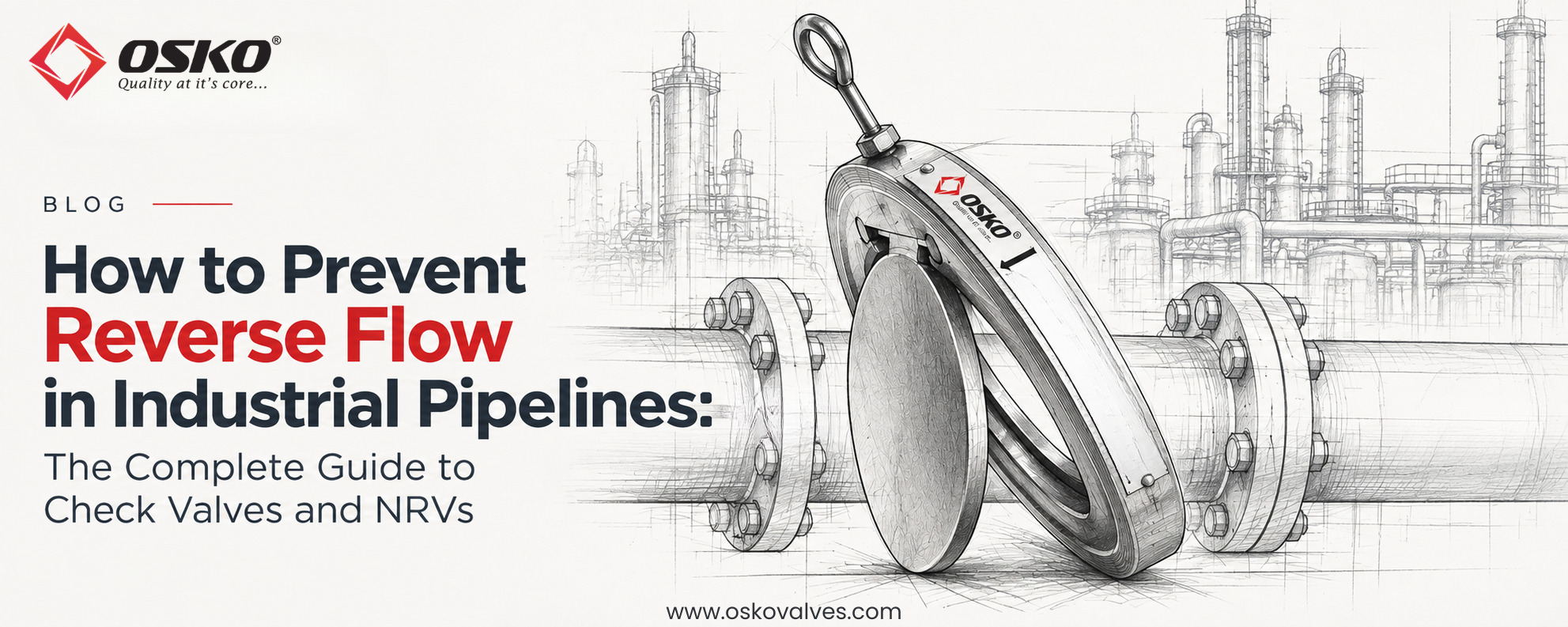
How to Prevent Reverse Flow in Industrial Pipelines
How to Prevent Reverse Flow in Industrial Pipelines:
The Complete Guide to Check Valves and NRVs
Most industrial plants have experienced it at least once. A pump shuts down, the pressure drops — and instead of the line simply going idle, the fluid runs backwards. The result: pump impeller damage, contaminated process lines, collapsed suction headers, or flooded sumps.
Reverse flow is not a low-probability event. In any system where pumps, compressors, or elevated storage tanks drive flow, the moment that driving force stops, backflow begins — unless the right valve is in place to stop it.
This guide covers every type of backflow prevention valve available in the OSKO range — how each one works, where it belongs, and what specifications to check before you order.
What Reverse Flow Actually Costs a Plant
Backflow is rarely dramatic until the damage is already done. The most common consequences:
- Pump damage — centrifugal pumps running in reverse rotation destroy mechanical seals, impellers, and sometimes bearings within minutes
- Process contamination — reverse flow in chemical dosing lines pushes concentrated chemicals back into distribution headers or storage tanks
- Water hammer — when flow suddenly reverses and a check valve slams shut, the pressure spike (water hammer) can burst pipe joints and damage instrumentation
- Loss of prime — in pump suction lines, reverse flow drains the suction header and causes the pump to lose prime, requiring manual intervention to restart
- Cross-contamination — in multi-line systems, backflow from one process stream enters another, causing quality failures or safety incidents
| The check valve is the only passive protection against reverse flow — it requires no power, no control signal, and no manual operation.
It either works correctly, or the consequences listed above unfold automatically. |
OSKO’s Backflow Prevention Valve Range — What’s Available
OSKO manufactures four types of backflow prevention valves at its plant in Rajkot, Gujarat. Each is designed for a specific set of applications — they are not interchangeable.
1. Disk Check Valve (Dual Plate / Spring-Loaded)
The disk check valve uses two spring-loaded half-discs (dual plates) that open under forward flow and snap shut the instant flow stops or begins to reverse. The spring closes the discs before the fluid can actually reverse direction — eliminating the slamming action and water hammer that plague swing check valves in high-velocity lines.
| Specification | OSKO Disk Check Valve |
| Size Range | DN15 to DN200 (15mm to 200mm) |
| Pressure Rating | PN40 |
| Design Standard | EN 558-1 |
| Testing Standard | API 598 |
| Face to Face | EN 558 |
| End Connection | Wafer — fits between ANSI 150#, BS Table D&E, DIN PN10 & PN16 flanges |
| Body/Disc Material | CF8, CF8M, Special Metals |
| Operation | Spring-loaded, self-operated — no external power or signal required |
| Key Advantage | No slamming action, low operating pressure drop, lapped seats for metal-to-metal seal |
Best applications: pump discharge lines, high-velocity water and process lines, chemical plant headers, compressor outlet lines, any installation where water hammer is a known risk.
| OSKO Disk Check Valves: wafer body, CF8/CF8M construction, PN40 rated. Spring-loaded dual-plate design — no slamming, no water hammer. Available from DN15 to DN200. |
2. Wafer Type Swing Check Valve
A swing check valve uses a hinged disc (clapper) that swings open under forward flow pressure and falls closed under gravity or reverse pressure. It is the simplest and most economical check valve design and works reliably in low-to-medium velocity lines where water hammer is not a concern.
Swing check valves are not suitable for vertical upward-flow pipelines (gravity cannot close the disc) and should not be used in high-velocity or high-cycle-rate applications where repeated slamming will damage the seat.
| OSKO Wafer Type Swing Check Valves: wafer body, fits standard flanges. Ideal for low-velocity horizontal pipelines — water distribution, drainage, general utilities. Contact OSKO for size range and material options. |
3. Ball Type Non-Return Valve (NRV)
A ball type NRV uses a spherical ball seated in the valve body. Forward flow lifts the ball off the seat, allowing flow. Reverse flow or loss of upstream pressure pushes the ball back onto the seat, sealing the line. The round ball provides full bore passage in the open position and a clean, positive seal on closure.
Ball type NRVs are particularly well-suited for viscous fluids, slurries, and media that would trap in the hinges or springs of other check valve designs. They also work in any orientation — horizontal, vertical, or inclined.
| OSKO Ball Type NRVs: full bore passage, self-sealing ball design, suitable for any pipeline orientation. Works reliably with viscous or particulate-laden media where disc-type valves would foul. Contact OSKO for specifications. |
4. Ball Type Foot Valve
A foot valve is a specialised check valve installed at the inlet of a pump suction line — submerged in the sump, tank, or source water. It prevents the suction line from draining back into the source when the pump stops, keeping the pump primed and ready to restart without manual re-priming.
Without a foot valve, every pump stop empties the suction line. The next start requires priming — which means manual effort, lost time, or a self-priming pump (which is more expensive and maintenance-intensive). A correctly sized foot valve eliminates all of that.
| OSKO Ball Type Foot Valves: installed at the pump suction inlet. Ball design for positive seal, no drain-back, pump always primed. Suitable for water, irrigation, and general fluid handling applications. Contact OSKO for sizes and materials. |
Which Check Valve for Which Application — Quick Reference
| Application | Recommended OSKO Valve | Key Reason |
| Pump discharge — high velocity line | Disk Check Valve | Spring closure prevents water hammer and slamming |
| Pump discharge — low velocity line | Wafer Swing Check Valve | Simple, economical, reliable at low flow rates |
| Pump suction line / sump installation | Ball Type Foot Valve | Keeps suction primed, prevents drain-back |
| Viscous fluid or slurry line | Ball Type NRV | No hinges or springs to foul, full bore passage |
| Vertical upward-flow pipeline | Disk Check or Ball Type NRV | Gravity-operated swing disc cannot close vertically |
| Chemical dosing or injection line | Disk Check Valve (CF8M body) | No slamming, corrosion-resistant material, PN40 |
| Compressed air or gas line | Disk Check Valve | Fast spring closure, no backflow of compressed gas |
| Water treatment / municipal pipeline | Wafer Swing Check or Disk Check | Cost-effective for large-diameter water lines |
| Irrigation pump outlet | Ball Type Foot Valve + Swing NRV | Foot valve keeps prime; outlet NRV prevents backflow |
5 Check Valve Mistakes That Cause Reverse Flow Failures
- Using a swing check valve in a high-velocity line.
At high flow velocities, the swing disc opens fully against the pipe wall. When flow stops, it slams shut with full hydraulic force — creating a pressure spike that can exceed 3–4× the normal operating pressure. Use a spring-loaded disk check valve in any high-velocity pump discharge application.
- Installing a swing check valve in a vertical pipeline.
Swing check valves rely on gravity to close the disc. In a vertical upward-flow line, gravity acts parallel to flow — it cannot close the disc. The result is no backflow protection at all. Use a disk check valve or ball type NRV in vertical pipelines.
- Omitting a foot valve on a deep sump or open tank installation.
Every time the pump stops, the suction line drains back into the sump. The pump loses prime and either fails to restart, overheats on a dry run, or requires manual re-priming before every start. A foot valve eliminates all of this at a fraction of the cost of the first repair.
- Under-sizing the check valve.
A check valve that is too small for the line creates excessive pressure drop and causes the disc to flutter (partially open and close repeatedly) rather than staying fully open. Disc flutter accelerates seat wear and shortens valve life drastically. Always size the check valve to the actual flow velocity, not just the pipe diameter.
- Selecting by price without confirming material compatibility.
A standard CI-body swing check valve on an acid dosing line will corrode within months. OSKO disk check valves are available in CF8 and CF8M stainless steel body and disc. Confirm your media chemical compatibility before specifying material grade.
Frequently Asked Questions
Q: What is the difference between a check valve and a non-return valve (NRV)?
They are the same function — both allow flow in one direction only and prevent reverse flow. ‘Check valve’ is the international term used in engineering standards. ‘Non-return valve’ or NRV is the commonly used term in Indian industrial practice. OSKO uses both terms across its product range.
Q: Can OSKO supply disk check valves in materials other than CF8 and CF8M?
Yes. Special metals are available on request — specify your media, operating temperature, and chemical environment at the time of inquiry. OSKO’s technical team will confirm the appropriate material grade.
Q: Do OSKO check valves come with test certificates?
Yes. All OSKO check valves are supplied with hydrostatic test reports confirming shell and seat test results. Material test certificates (MTC) are provided as standard. Third-party inspection can be arranged for project requirements — confirm at order stage.
Q: What is the minimum pressure required to open the disk check valve?
OSKO disk check valves are rated for low operating pressure — meaning they open at low differential pressure across the valve. This makes them suitable for low-head pump systems where a high cracking pressure would reduce effective pump output. Contact OSKO with your available pump head and we will confirm suitability.
Q: Can a foot valve be used with a submersible pump?
Foot valves are designed for surface-mounted pump suction lines, not for use with submersible pumps (which are lowered into the fluid). For submersible pump installations, a check valve on the pump outlet header is the appropriate protection.
Reverse Flow Is Preventable — If You Specify the Right Valve
Every industrial plant with pumps, compressors, or gravity-fed lines needs backflow prevention. The question is never whether to install a check valve — it is which type, in which material, at which location.
OSKO manufactures disk check valves, swing check valves, ball type NRVs, and ball type foot valves at its plant in Rajkot, Gujarat. All products are pressure-tested before dispatch. Our team can review your pipeline layout and recommend the right check valve for every service point — before you commit to an order.
| Send us your requirement.
Share your pipeline details — line size (DN), operating pressure, media, flow velocity, and any certification requirements — and OSKO will recommend the right check valve with full specifications and pricing within 24 hours.
Call / WhatsApp: +91 8866226757 | +91 8866221646 Email: info@oskovalves.com Website: www.oskovalves.com
|
Popular Post
Categories
Recent Posts
- How to Prevent Reverse Flow in Industrial Pipelines
- Pneumatic vs Electric Actuated Valves
- How to Buy Industrial Valves from an Indian Manufacturer
- Wafer vs Lug vs Flanged Valve: Which End Connection Is Best for Your Industrial Plant?
- How to Select the Right Valve for a Chemical Plant | Complete Guide